Monday, February 20, 2006

Oskar Schindler and Generosity


I have seen the film Schindler’s List only once when I was 16 years old. Yet this scene has remained with me ever since.

Schindler (to himself) I could've got more... if I'd just... I don't know, if I'd just... I could've got more...

Stern Oskar, there are twelve hundred people who are alive because of you. Look at them.

He can't.

Schindler If I'd made more money... I threw away so much money, you have no idea. If I'd just...

Stern There will be generations because of what you did.

Schindler I didn't do enough.

Stern You did so much.

Schindler starts to lose it, the tears coming. Stern, too.

The look on Schindler's face as his eyes sweep across the faces of the workers is one of apology, begging them to forgive him for not doing more.

Schindler This car. Goeth would've bought this car. Why did I keep the car? Ten people, right there, ten more I could've got. (looking around) This pin --

He rips the elaborate Hakenkreus, the swastika, from his lapel and holds it out to Stern pathetically.

Schindler Two people. This is gold. Two more people. He would've given me two for it. At least one. He would've given me one. One more. One more person. A person, Stern. For this. One more. I could've gotten one more person I didn't.


We live in the 15th richest country in the world (GDP per capita) while 27,400 children die of preventable causes every day. What should our response be to the vast inequalities that make our lives possible?

Thursday, February 02, 2006

Friday, January 27, 2006

Newbigin and Politics

My interest in politics has recently been revived after a few encouraging conversations with an old friend and watching Gorgeous George on celebrity big brother (I know, big brother, yes, I'm a hypocrite). At the same time, a few of us from church have been studying Leslie Newbigin's brilliant 'Foolishness to the Greeks'. In commenting on the great left/right divide, Newbign argues that both positions arise from a similar starting point,

'In the one case (capitalism), freedom is pursued at the cost of equality; in the other (socialism), equality is pursued at the cost of freedom. Both derive from the Enlightenment vision of human beings as autonomous individuals with innate and equal rights to pursue self-chosen ends to the limit of their powers.'

He then goes on to outline how a the gospel provides a true alternative that critiques the very basis of contemporary politics,

'From its first page to its last, the Bible is informed by a vision of human nature for which neither freedom nor equality is fundamental; what is fundamental is relatedness. Human beings reach their true end in such relatedness, in bonds of mutual love and obedience that reflect the mutual relatedness in love that is the being of the Triune God himself. Neither freedom no equality are words that can take us to the heart of the matter.'

A truely challenging perspective.

Sunday, January 15, 2006

The Exorcist


For years I chose not to watch 'The Exorcist'. I thought it was an evil film, a film that Christians shouldn't watch, a film that could damage me spiritually. About six months ago I finally changed my mind. I was suprised by what I saw. Far from being a demonic film that endangers the spiritual health of its viewers, I found 'The Exorcist' to be a film about the battle between faith and science.

The film is about two journeys. On the one hand, we meet a mother (Chris McNeil) with a troubled daughter (Regan McNeil). In the search to help her daughter, Chris exhausts the resources of the medical profession both somatic and psychiatric to no avail. As a last resort, the doctors suggest she asks the church to help solve her daughter's problems.

On the other, we meet Father Damien Karras, a priest with a troubled faith. As a result of his training in psychiatry, the conflict between faith and science had started to get too much. After encountering the possessed Regan, however, he begins to change his mind. In the McNeil household, Father Karras comes face to face with a mystery that science could not explain.

Both journeys expose the myth that science explains all. Once Father Karras has grasped this, he commits the ultimate act of self-sacrafice to save Regan. He takes the possession onto himself and ends his own life.

What a film!

Sunday, January 08, 2006

London life in Swansea

Only been back to work for a week and already Christmas and New Year feel like a distant memory. Four deadlines and a discussion group to lead all before the end of January, looks like I won't get to ease myself slowly into 2006. I thought life in Wales was going to be much more laid back than this!

Tuesday, December 20, 2005

Elders, Age and Respect


I’ve been spending some time reflecting on age, wisdom and life over the last couple of weeks. As young-ish people, we are often accused of lacking respect for the old, writing off our seniors as obsolete, and ploughing ahead with our own ideas without respecting tradition. Other cultures don’t seem to share our youthful arrogance; they look to the past in order to find a way forward. Here is a great quote from a book I am reading at the moment,

‘The destination component of ‘walking with God’ offers a metaphor of progress for describing a disciple’s old age and death. The life of the old person is approaching its ‘natural’ outcome, an even closer relationship with God than has characterised the whole journey. This metaphorical perception of the final stage of the journey with God can and does function to transform self-perception, enhance dignity and offer some comfort for ageing mortals.’

I want to add that it also transforms the perception of the young. It exposes our experience and knowledge for what they are, wisdom in waiting.

Thursday, December 08, 2005

Update

This week has been tough, my grandmother passed away on Sunday night. I've wanted to stop, take time and try to adjust, but life has carried on at its usual pace. I've found this difficult. This week has seemed unreal. Through all of this, I've found the words of Thomas Merton to be a source of comfort. While words desert me, and conversation with God feels pointless, he looks to something that transcends my understanding of prayer.

'The ever-changing reality in the midst of which we live should awaken us to the possibility of an uninterrupted dialogue with God. By this I do not mean continuous "talk", or a frivolously conversational form of affective prayer which is sometimes cultivated in convents, but a dialogue of love and of choice. A dialogue of deep wills.'

Wednesday, November 30, 2005

And Finally......


From June 2004 - June 2005, I was studying for an M.Phil in The University of Birmingham, researching into the area of using hydrogen instead of fossil fuels to provide for humanity's energy needs. During that year, I became increasingly aware of the dire situation that the human race finds itself in. With global temperatures increasing significantly, and the frightening possibility of a 'point of no return', things aren't looking good. As a result of this revelation, I began reflecting on my own personal actions and contribution to the wider problem, hence the inclusion of 'Our World' in my spirituality plan. Since moving from Birmingham I've failed to continue many of the practices that I started. Only recently have I begun to revive things.

Our World
Only use a car when absolutely necessary
Use a renewable energy provider
Recycle as much waste as possible
Buy locally produced food where possible

Let me know what you think, what you do, and what you would like to do (I'm expecting big things from the Scrivners).

Friday, November 25, 2005

Light a candle, say a prayer

As someone who struggles to pray, I found this to be really helpful. It takes about five minutes and is worth every second. Thanks to Maggi for the link.

Sunday, November 20, 2005

Spirituality II


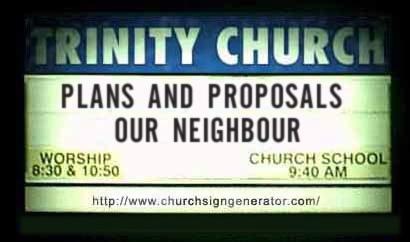
Of the three areas of spirituality I mentioned in my last post, Our Neighbour is the one that I find most difficult to plan for. There are so many needs, both local and global, that I find myself paralysed by the enormity of the task which usually leaves me doing absolutely nothing. The list below is a work in progress. Since coming back to Swansea I have begun to tackle the first and the last practices, but am still struggling to fit the middle two into my routine. Let me know what you think.

Our Neighbour
Use ethical banks
Buy ethical clothes
Volunteer on a regular basis
Give some money away

Sunday, November 13, 2005

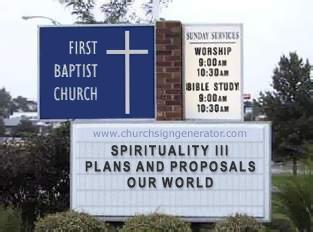
Spirituality: Plans and Proposals

One of my lecturers used to say ‘Spirituality is an external manifestation of our internal desires, or more simply, how we live in the world’. On the basis of this, I have been periodically reflecting on how my internal desires (the ones that reflect God’s kingdom that is) are being played out, if at all, in the world of everyday life.

One of my central motivations in joining this whole ‘blog community’ thing was so we could begin or continue (depending on how well we knew each other before) to encourage and motivate each other to live lives that reflect that higher purpose (I think even the Scrivners can include themselves here) that we all want to be a part of.

My spirituality reflections tend to come under three headings, Our God, Our neighbour and Our world; and they detail various practices that I feel will help me live out my internal desires in the immediate future. Given the current state of my journey, I thought I would begin with Our God (I’ll probably post the rest over the next week or so). Please let me know what you think, offer me advice or even better, post your own spirituality plans.

Our God
Immerse myself in the sacred narrative of Christianity
Study and learn from the history of the Christian tradition
Keep a prayer journal
Repeat the Lord’s prayer daily
Pray the rosary
Follow the traditional Christian calendar

Saturday, November 05, 2005

New Zealand 41 : Wales 3

Outplayed, outclassed and overpowered. Gutted.

The main mitigating factor was the absence of seven first choice players, but then losers are often found making such excuses. While Wales may be the current dominant force in Northern Hemisphere rugby, the South appear to be in a league of their own.

Are New Zealand the best in the world? Only after the 2007 world cup will we know for sure. In terms of the current tour though, it is difficult to see anyone beating them.

Tuesday, November 01, 2005

It's been a while

Life has been busy recently. A stag night, a fantastic wedding and the busiest week at work so far has meant blogging has taken a back seat. Anyway, back to buisness...

Halloween came and went and not one trick or treater graced our doorstep for the second year running. Maybe all the kids were out at Halloween parties, or maybe they just heard that I am tight.

All the Halloween festivities on television have got me and Becky thinking about what role Halloween will play when we have kids. Will they be allowed to celebrate with the rest, or is there something more sinister lying beneath it all? When I was younger, my church used to put on Christian parties to compensate; looking back now it just all seems a bit 'Ned Flanders' to me.

We ended up coming to the conlusion that we probably would let our kids celebrate Halloween. What do you think?

Thursday, October 20, 2005

Interpretation, a shining example

A few of us have recently been having a discussion about interpreting the Old Testament. Interpretation is always a difficult task, whether we are dealing with ancient texts or contemporary cinema we always run the risk of missing the point. This problem is brilliantly illustrated by a slightly different take on the film 'The Shining' (thanks to Si for the link). You can view the trailer here.

Wouldn't you just love to have a foster father like Jack?

Friday, October 14, 2005

The Journey: Destination and Process

The last six years have proved to be fairly complex in terms of my faith and spirituality. I have had many highs and lows, and the sheer pace of life has turned what could have been a pleasant stroll into a rollercoaster ride that is difficult to get off. From being a happy clappy ‘God is cool’ Christian, I became an angry bitter self-righteous cynic and am currently located somewhere in-between the two.

As a result of these experiences, I have found the concept of ‘journey’ to be a useful metaphor for my spiritual life. It has provided me with a framework to cope with my ups and downs. Whether I am taking on new beliefs or rediscovering old ones, I am able to see myself as heading towards a destination.

I have been reflecting this week on the differences between destination and the process of the journey itself. In my case, the destination is God; that is where I am heading. However, the manner in which I am getting there is not so straightforward. When I lost my faith, I focused all my energy into sorting through the mess myself. While I had significant conversations with those around me, the majority of progress took place within my own mind, on my terms.

The journeys in the biblical narrative not only have God as the destination but also as co-traveller. While I may have the former, the latter is alien to me. I do not know what it is like to ‘walk with God’. To journey with God is to lose my autonomy, something I find very difficult to give up. It would mean a walk characterised by obedience, a life beyond my own control. Maybe this is what it is to know God.

Any thoughts or advice?

Friday, October 07, 2005

Individualism and Consumerism

Kiera e-mailed me the other day to point me to this article written by a guy called Mark Sampson. It’s a great piece and highlights individualism and consumerism as the two big problems that face the church in our day. However, while Mark highlights the issues well, he doesn’t give us much advice on how to deal with these two behemoths (not a criticism, just an observation; probably not his intention anyway).

Andy Crouch has written an excellent article on how the sacraments themselves (particularly baptism and the Eucharist) are potent resources for those wanting to follow Christ in the world. Here are his main points:

In Paul’s letter to the Romans, it is clear that baptism was central to the self-understanding of the early Christians. Paul argues that when we present our bodies to God (the same bodies risen from baptism), we are one body, not many (Romans 12). As we begin to ‘live out’ our baptism, we are offered a model of true community living.

While baptism aids us against individualism, the Eucharist offers us a way past consumerism. At the table we consume the simplest of foods, the meal does not nourish us and yet is the ‘bread of life’ and the ‘fruit of the true vine’. Nobody gets preferential treatment, all have the same meal and there is no menu with a hierarchy of products.

Many of us from low-church backgrounds tend not to practice the sacraments much, if at all. Are we missing the point?

Sunday, October 02, 2005

The Soap Opera: Opt-out for the socially stunted or Valid moral forum?

I’ve had some interesting conversations over the weekend with Rosie, James and Ben that have got me thinking again about the worth, or lack thereof, of soap operas. I used to hate them. As far as I was concerned, they were for people who preferred to spend their time following fictional creations rather than getting involved with real people and communities. I don’t think that anymore. After spending a year or so living with my wife’s Eastenders addiction, some of her arguments have begun to persuade me otherwise.

The soap opera can be an effective forum where ethical issues that would otherwise go un-discussed invite comments and opinions from all who watch. In a culture like ours, where morals and values tend to be ignored in much public discussion, the soap opera provides an opportunity to contemplate the good and the bad in life. Fair enough, there is a lot of rubbish around (anyone who saw Peggy Mitchell throw Chrissy into the grave of twice dead Dirty Den will agree), but many serious issues are also covered (e.g, Adoption, terminal illness and child abuse to name but a few).

What do you reckon?

Friday, September 30, 2005

Knitting Update


Well, as promised, here is a picture of my work in progress. It's not very big, I know, but then I've been a bit busy over the last week and time has been a bit limited. The measurements are 6 inches from left to right, and 1.5 inches top to bottom. There's a long way to go.

Rosie and James are coming to stay with us this weekend. Really looking forward to seeing them again. As a result, blog will be quiet. Until Monday.

Monday, September 26, 2005

Old Testament Interpretation II

The same lecturer who made the analogy I used in my previous post, has some interesting thoughts on this issue. Below is my understanding of his main argument.

The Old Testament was written, read and then re-read by communities down through history, up to the present day. In fact, it was the re-reading and re-appropriation of many of the Psalms that led to their collection and eventual canonisation. For example, Psalm 2 starts ‘You are my Son, today I have begotten you’. This was probably used originally at successive Judean king’s coronations. However, it was likely collected and canonised due to eschatological re-readings surrounding hope (that is re-readings appropriating the language to the Messiah), after the exile to Babylon. And more recently, the passage has been re-read christologically (that is with Christ in mind) by the New Testament writers (e.g Heb 1:5). The process of re-reading and appropriation is therefore intrinsic to much of the Old Testament.

Jesus also partook in the tradition of re-reading the psalms. His beatitude about the meek inheriting the earth is a re-reading of an ancient Hebrew idea expressed clearly in psalms 25 and 37 (amongst others); the idea of land. In his appropriation, Jesus stretches ‘land’ to refer to the whole earth, he stretches the chronology of the passage to refer to the Age to come, and his promise includes all followers of Jesus, not just the nation of Israel.

Jesus constructs a trajectory of meaning that arches across time, cultures and covenants. The pillars of this trajectory include Deuteronomy and psalms 25 & 37. This allows us to bridge the chasm between author and reader without denying it’s existence.

What do you all think, a solution or not?

Thursday, September 22, 2005

Old Testament Interpretation

Tim has recently been making some noise, both on and off his blog, around the issue of authority and the Old Testament. I have been struggling with the problem of how the OT text can be interpreted today. While I like the idea of reading the OT within a narrative context (see Tim’s post), I don’t see how setting it in the context of a story makes interpretation any easier. There is still a gap between the then and now that makes appropriation difficult. If we read the text as it’s contemporaries would have read it, then we lack application today; yet if we read it with today in mind, we run the risk of distortion.

One of my lecturers has used the analogy of a young couple looking to rent a flat to describe the dilemma. There is a tension between the original state of the property as the lease agreement was signed, and the degree to which the couple may alter the flat to make it their own. A subjective reading of the OT takes the view of the tenant, but when does the re-decorating of the original become a distortion and not an enhancement. A more objective reading would take the view of the landlord; that the apartment should stay as originally designed without any alterations or modifications, leaving the tenants without a homely environment.

In fact, this is not a problem only for the OT. To a lesser degree, we have a similar appropriation gap with the New Testament texts. What are peoples thoughts on how to solve/ live with this problem?